
The End of the Coal Industry in West Virginia?


Written by: Tessy Schreyer
Edited by: Ashley Yeung
Junior Division
The United States experienced a drastic 54% drop in coal production from 2005 to 2020 (Bowen et al., 2020). States and communities with economic structures deeply entrenched in the coal industry face various pressures to respond to the growing pains from these changing tides. West Virginia is one of many states known for its emphasis on coal production. Though its coal production varies by region, it remains the only state located entirely in the Appalachian region of the U.S., making coal a key part of its identity. Its landscape is full of mountains, forests, and rich coal deposits that have fueled the U.S. throughout its history (Dong et al., 2024).
The coal industry has been present in Appalachia ever since small-scale mining began in Pennsylvania in the 19th century. By 1919, coal mining in Appalachia made up two-thirds of all U.S. mining employment (Elizabeth Ruppert Bulmer et al., 2021). On the national scale, coal production dipped after World War I but bounced back soon after, increasing 250% from 1954 to 2002 (Elizabeth Ruppert Bulmer et al., 2021). Since the early 2000s, however, coal production throughout the U.S. has experienced a significant overall decrease (Appalachian Regional Commission, 2024). A decline so drastic hits coal-dominated communities, such as those concentrated in Southern West Virginia, especially hard in several respects.

The 14 Coalfields of West Virginia
Source: U.S. Library of Congress
Even in the face of declining demand, West Virginia's coal industry could not simply disappear overnight. Many have a vested interest in the industry and a diverse range of stakeholders are involved. Moreover, decommissioning coal plants can be costly and time-consuming, and it requires government approval. Additionally, building new infrastructure requires heavy investments upfront. No quick fix could be found, as divisions on how to respond to declining coal demand have always gone beyond a global call to cut fossil fuel emissions. Some believe strongly in coal as a part of their identity, and that the solution can be found by making the industry more efficient. Others see the need to have it as baseload energy, while some claim coal is no longer a feasible economic or environmental reality for West Virginia. No matter what one believes, it has been difficult to reconcile these points of view in order to come to a single solution.
Not only is the West Virginian economy and identity deeply entrenched in the coal industry, but the state faces numerous societal struggles that are, in part, related to the industry and its decline. Given the unique challenges West Virginia faces and the various interests at odds, a just transition appears difficult to achieve. A just transition implies leaving no one behind as society moves towards more sustainable practices, which means that local or regional economies which are greatly reliant on producing fossil fuels for income may need assistance in restructuring their economies to lower-emitting sectors initially (What Is Just Transition?, 2024).
Generally, coal mining communities in Appalachia, including those in West Virginia, face similar societal and economic issues, which have been partially produced by the presence of the coal industry and the impacts of its decline. According to the National Institutes of Health, economic stress in Appalachian communities is common in areas with low economic diversification and low education rates (Hendryx & Ahern, 2009). Such a lack of diversification is tied to the dependence on the coal industry. In a time of decline for a historically-dominant industry, Appalachian states like West Virginia sit in a stressful position, where making a just transition could offer relief for their coal-dependent economies and resolve societal issues tied to their coal mining history. The state must address unemployment and poverty while caring for the residual effects of these factors on residents' mental and physical health.
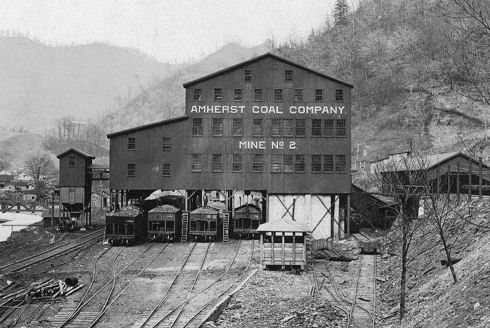
Logan County Mine
Source: Mining Artifacts
How has the industry's decline impacted West Virginia’s communities?
In 2024, 16% of the state population was assisted by SNAP benefits, and 16% of the state were living below the poverty line (West Virginia Supplemental Nutrition Assistance Program, 2025). Additionally, energy prices in West Virginia are higher than ever due to external market forces that have heightened the cost of coal, which accounts for 86% of the state’s energy. These rising prices impact West Virginians severely, as many must pay an increasingly large chunk of already slim incomes on more costly energy (Penn, 2025). Further, the mass unemployment in the industry has enormous psychological and physical health implications (Penn 2025). West Virginia's communities are faced with heightened incidents of lung disease, cancer, and cardiovascular disease, linked to the mining and burning of coal. Additionally, diseases of despair, including overdose, suicide, and liver disease, are significantly more common than the national average (Dong et al., 2024). For example, Logan County, located in the heart of West Virginia's coal industry, has been harshly hit by the opioid epidemic. In 2021, it was the fourth-largest coal producer in the state, however the county was also dealing with the highest opioid-related mortality rate in the state (Young et al., 2023). At large, unemployment is highest in the largest coal-producing communities; according to recent research, these same communities tend to experience disproportionately high deaths from circulatory problems, respiratory illnesses, drug overdoses and suicides, and endocrine-related diseases (Young et al., 2023).
Residents facing unemployment must deal with mental battles while fighting to keep their livelihoods intact, suffer from the chronic health impacts of industry pollution, and feel their identity weakened by the demise of the coal industry (Penn, 2025). What was once hard and respectable work that supported families is no longer an abundant opportunity, nor can it fuel homes as easily due to rising prices and faltering demand (Tate, 2025). Yet, West Virginia's counties’ and state governments remain conflicted about turning away from coal as well as how this could be accomplished.
Will the state make a “just transition”? And how?
While a consensus to shift away from coal has not yet been reached, many are working to offer opportunities independent from the coal sector. Efforts to overcome environmental and social challenges to uplift West Virginians, as well as to transition the economy are being made in all sorts of ways. For one, in 2021, the Economic Development Agency (EDA) announced a federal program called the Build Back Better Regional Challenge (BBRC) which set aside one billion dollars to allocate to coalitions organizing projects to promote equity and economic transformation. West Virginian actors banded together to submit a project that would execute their initiatives on a grand scale. “Community organizations, higher education, government, and industry came together to form the ACT Now Coalition” and synthesized equity-focused projects to submit for the BBRC to facilitate economic development in a time of industry decline. The coalition was awarded 62 million dollars to carry out eight projects that included subsidizing job training, expanding university education opportunities, analyzing and allowing for investment in the clean energy sector, remediating abandoned mines, improving solar power and recycling logistics, and creating an economic transition center (Love, 2024). Each project had a lead actor and numerous partners to implement it; for example, the Community and Business Resilience Initiative - which aimed to support planning and development for 16 communities in order to promote equity - was led by the West Virginia Community Development Hub and partners like Advantage Valley, New River Gorge Regional Development Authority, WV Brownfields Assistance Centers, AFV Educate, various NGOs, and local municipality governments of the communities they were focusing on (Love, 2024). Further, the coalition is made up of communities that have experienced persistent poverty in an effort to ensure that those who are most vulnerable are leading the transition to make change in the economy they know the best. Each project and its team represents the abundance of investment that West Virginia is willing to put forth at all levels of society.
Similar to BBRC, the Inflation Reduction Act (IRA) sought after similar goals in 2022. The IRA provided 900 million dollars to Appalachian communities' economic transition efforts - the largest investment in Appalachia since the 1960s. One beneficiary of this spending is also heavily involved in the ACT Now coalition: Coalfield Development, based in southern West Virginia. As West Virginia simultaneously battles unemployment, environmental concerns, poverty, and the opioid crisis, Coalfield Development operates at the community scale to rebuild social fabric, help individuals find their place in society, and promote more sustainable economic practices. Coalfield has trained more than 4,000 people over 15 years, many of whom were previously incarcerated or are recovering addicts, in a diverse set of jobs such as solar installations, hanging drywall, and first aid care (Lakhani, 2025). The nonprofit is investing directly in its people to make meaningful work possible and partnering with other local nonprofits, social enterprises, businesses, and educational institutions to unite society in its path forward.
Programs like the ones started by Coalfield are present throughout the state in many forms. Another grassroots effort comes in the form of social enterprise. Fruits of Labor was started by a West Virginia local with a crucial mission: to bring hope to communities. Social enterprises like this one are created primarily to make positive social change. What began as a farm-to-table cafe has expanded into several cafes and bakeries, whose revenue and other funding are able to support their foundational programs (Kobersmith, 2022). At no cost to participants, Fruits of Labor offers culinary training to adults recovering from substance misuse disorders to re-enter the workforce, in addition to prevention programs for youths (Home, n.d.). The culinary training places a focus on a philosophy of buying local, and throughout their education, students experience the entire food production cycle, from planting to consumption, and are then asked to use these skills to develop seasonal recipes.
Non-profits and social enterprises like Fruits of Labor, Coalfield Development, and projects under the ACT Now Coalition, with help from federal grants, mobilize stakeholders in rural communities, many of whom were already working to address societal issues, and fortify their work. In offering more resources, community members are able to strengthen and amplify the impact of their work. They are actively changing individual lives in ways that are enormously important.

Fruits of Labor Cafe
Source: Candice Lately Blog
It is no secret that the Trump administration, as of 2025, has put forward 175 million dollars to modernize and extend the lifetime of coal-fired power plants in rural communities, rolled back environmental regulations on mining and energy production, and stripped many of the aforementioned grants away (Jenkins, 2026). Such a policy pivot sends mixed signals about what direction West Virginia is headed in. It also works in direct opposition to those who hope to spend significant amounts on transitioning away from coal and competes with greater market signals that have made coal infrastructure and production less competitive. Further, Trump won an average of 70% of the vote in all West Virginia counties despite his funding reductions for programs including Medicare, SNAP, and grants to boost West Virginia's economy that many across the state rely on (Lakhani, 2025).
Opinions do not ubiquitously support abandoning coal, and different interests and viewpoints make the solution increasingly complex. It is widely accepted that people want better for their communities, although ideas of how to achieve this may differ. The impacts of the Trump administration's actions are still playing out, being appreciated by some and contested by others. Yet, those who are motivated to propel a just transition in the state or even simply to offer better opportunities in their communities remain, and have not faltered in their commitment to making West Virginia a healthier and happier place for its inhabitants.
References
Appalachian Regional Commission. (2024). Coal Production and Employment in the Appalachian Region 2000-2023.
Bowen, E., Christiadi, Deskins, J., & Lego, B. (2020). An Overview of Coal and the Economy in Appalachia. Commissioned by the Appalachian Regional Commission.
Dong, J., Browning, M., Reuben, A., McAnirlin, O., Yuan, S., Stephens, C., Maisonet, M., Zhang, K., Hart, J. E., James, P., & Yeager, R. (2024). The paradox of high greenness and poor health in rural Central Appalachia. Environmental Research, 248, 118400. https://doi.org/10.1016/j.envres.2024.118400
Elizabeth Ruppert Bulmerb, Linda Lobaoa, Mark Partridge, Oudom Heana, Paige Kellya, & Seung-hun Chunga. (2021). Socioeconomic transition in the appalachia coal region; Some factors of success (No. 165479). World Bank. https://documents1.worldbank.org/curated/en/531201635134585522/pdf/Socioeconomic-Transition-in-the-Appalachia-Coal-Region-Some-Factors-of-Success.pdf
Hendryx, M., & Ahern, M. M. (2009). Mortality in Appalachian coal mining regions: The value of statistical life lost. Public Health Reports, 124(4), 541–550. https://doi.org/10.1177/003335490912400411
Home. (n.d.). Cafe | Bakery | Culinary Training Center | Fruits of Labor, Inc. Retrieved March 4, 2026, from https://www.fruitsoflaborinc.com
Jenkins, J. (2026, February 12). Trump announces Department of Energy investment in coal-fired power plants including 3 in West Virginia. WV MetroNews. https://wvmetronews.com/2026/02/12/trump-announces-department-of-energy-investment-in-coal-fired-power-plants-including-3-in-west-virginia/
Kobersmith, K. (2022, April 1). Fruits of labor cafe dishes up hope for those in recovery. The Daily Yonder. https://dailyyonder.com/fruits-of-labor-dishes-up-hope-for-those-in-recovery/2022/04/01
Lakhani, N. (2025, November 29). ‘Deeply demoralizing’: How Trump derailed coal country’s clean-energy revival. The Guardian. https://www.theguardian.com/environment/2025/nov/29/trump-coal-country
Love, H. (2024, May 21). Catalyzing a ‘just transition’ from coal to clean energy in West Virginia’s Coalfields. Brookings. https://www.brookings.edu/articles/catalyzing-a-just-transition-from-coal-to-clean-energy-in-west-virginias-coalfields/
Penn, I. (2025, September 29). Energy bills are soaring in America’s coal capital. https://www.nytimes.com/2025/09/29/business/west-virginia-electricity-prices-coal.html
Tate, C. (2025, April 21). A push for more coal has some in West Virginia worried about electricity prices. NPR. https://www.npr.org/2025/04/21/nx-s1-5366824/a-push-for-more-coal-has-some-in-west-virginia-worried-about-electricity-prices
West Virginia Supplemental Nutrition Assistance Program. (2025, January 21). [Factsheet]. Center on Budget and Policy Priorities.
What is just transition? And why is it important? | UNDP Climate Promise. (2024, February 29). https://climatepromise.undp.org/news-and-stories/what-just-transition-and-why-it-important
Young, T., Baka, J., He, Z., Bhattacharyya, S., & Lei, Z. (2023). Mining, loss, and despair: Exploring energy transitions and opioid use in an Appalachian coal community. Energy Research & Social Science, 99, 103046. https://doi.org/10.1016/j.erss.2023.103046



One aspect that stands out is the discussion of respiratory disease, cardiovascular illness, and mental health challenges in former mining communities. This highlights the close relationship between industrial change and environmental health, emphasizing the need for interdisciplinary research to support healthier communities.