
Inside the McGill Energy Centre’s First Energy Forum: Canada in the Global Energy Transition

Writer: Ethan Brown
Editor: Sophia Eli
Senior Division
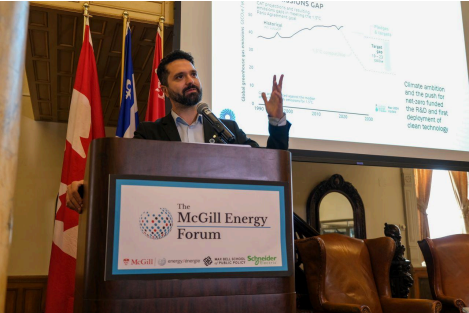
On May 25th, 2026, the first annual McGill Energy Forum was hosted by the McGill Energy Centre in coordination with the Max Bell School of Public Policy and with the support of Schneider Electric. It explored Canada's evolving energy transition amidst nation-building priorities, security imperatives and trade reorientation through panellists, speakers, and workshops. Attendees included students, professors and representatives from NGOs.
Three unique workshops comprised the first portion of the forum. Jeff Bergthorson, Director of the McGill Energy Centre and Professor of Mechanical Engineering, delivered a workshop on energy analysis. It provided a unique comparison of energy systems through the foundation of scientific principles. Karl Janelle from Community Energy Cooperative Canada spoke on energy democracy, exploring alternative pathways for a just, community-led transition.
I chose to attend the session delivered by Derrick Wong, a course lecturer and start-up industry professional from the McGill Engine Centre, due to my interest in private-sector economics. This workshop called “Pathways to Commercialization” was particularly exciting given the relevance of commercializing and deploying clean technology. It attracted a large range of people, from students and professionals to even interns for a Member of Parliament. Through the examination of a series of cases, the workshop explained the process by which emerging technologies become financed and eventually present in society.
Mr. Wong started by providing the audience with a framework for evaluating inventions and innovations. He raised three key questions: Does it work? Can it scale? Is it repeatable? He then introduced the core concept of a minimum viable product (MVP). It is the fundamental features of the product that consumers can adopt and provide feedback on. For example, if a startup has an idea to share solar panels throughout a neighbourhood, the MVP would be to test-run this idea by installing a solar panel and manually tracking, billing, and distributing the shared energy credits to a handful of neighbours.
Subsequently, Mr. Wong applied the MVP framework to certain examples of energy technology, such as solar and potential nuclear fusion. To improve our understanding of how startups find new applications for existing energy technologies, we took part in a group activity with the aim of finding customers and uses for energy, notably for nuclear energy with a small modular reactor. Teams determined that some demands for on-site energy can come from utility companies, humanitarian projects, electric vehicle charging stations, or remote Indigenous communities.
To conclude this workshop, Mr. Wong discussed the stages of financing a startup. We learned how this process typically advances when successful. Entrepreneurs gain small amounts of capital from friends and family. Then, as the startup gains momentum, entrepreneurs must deal with the hard reality of venture capitalists choosing to take on the risk of failure from a given startup company in exchange for equity and a future return. Overall, the workshop offered a crucial framework for analyzing the progression of start-ups. This is valuable as startups often propel cleaner technologies into the wider economy, so understanding how they work gives us a better idea of the energy transition.
Within the other workshops, mechanical engineering Professor Jeff Bergthorson covered energy analysis, which provided a unique comparison of energy systems through science. Karl Janelle from Community Energy Cooperative Canada spoke on Energy Democracy, exploring just-community driven energy transition pathways. The broad array of topics presented at the McGill Energy Forum was a highlight of the event.
In the afternoon, participants attended a series of panel discussions. The topic of discussion in the first panel was Canada’s energy transition in the political context. While many Canadian stakeholders recognize the need for a quick, seamless transition to a clean energy future, individual approaches have differed widely, in part due to political views and role within society. The panel helped to reveal the connections between progress on sustainable energy and the current Canadian political situation through their wide range of experiences:
Amy Janzawood, jointly appointed professor in the Department of Political Science and the Bieler School of Environment, gave insight into the proposed oil pipeline in Alberta regarding both the sentiments of Indigenous Nations and the dynamics between the Alberta Provincial Government and the Federal Government.
Moe Kabbara, CEO of the Transition Accelerator, an organization driving projects, partnerships and strategies to ensure Canada is competitive in carbon-neutral work. The Transition Accelerator collaborates with over 300 partner organizations to advance the objective of a prosperous low-carbon economy. In the discussion, Mr. Kabbara brought up the federal government initiative to double the capacity of the country's electricity grid, primarily through clean energy, to meet increasing demand from EVs and other new technologies. In particular, he spoke about the promising politics of developing clean offshore wind energy in Atlantic Canada.
Jen Hiscock, Director for Batteries, Buildings, Electricity & Regulatory Innovation at Natural Resources Canada, shed light on the logistics and political imperatives of achieving energy goals. She detailed collaboration efforts required between municipal, provincial, and federal governments in order to realize an effective transition to a resilient and reliable electrical grid.
A second panel then explored how firms can navigate and adapt to the emerging opportunities of the energy transition. Panellist Michel Carreau, Regional Director of eGrid Eastern Canada at Hatch, highlighted relevant engineering debates in the province of Quebec to satisfy energy demand with hydroelectric power. He mentioned the complexity of factors to consider when deciding where to build a dam, such as predicting how efficiently it will produce electricity. Michel also brought up the issues Hydro-Québec debates when determining whether to close down an old dam or even whether to import energy from another province.
Following Michel, panellist Oren Reich, Principal in the Energy Infrastructure Equity team at Power Sustainable, approached the clean energy transition through a more business-oriented mindset. Within Power Sustainable, an asset manager for companies addressing sustainability and environmental challenges, Oren leads the function of financing mergers & acquisitions and financing sustainable projects.
In an interview with the McGill Energy Journal, Oren shared that he felt that he contributed to the panel by outlining the logistics and day-to-day realities of developing a clean energy project. Despite these challenges, Oren is very hopeful about a successful energy transition. Along with a deep interest in the clean energy sector, Canada generally has constructive policies implemented, such as targeted tax credits. Oren believes Canada is at a structural advantage for the clean energy transition. Canada has tailwinds because of its abundant natural resource quality, technical expertise, and growing clean power demand. In many cases, there is meaningful capital for companies to promote environmentally friendly ideas. Drawing on his experiences in the Canadian business sector, Oren observes that some entity is usually ready to build a green project or buy a given startup.
While reflecting on the forum, Oren expressed satisfaction that it offered such a diversity of perspectives. He recommended that, in the future, the Energy Centre invite an even wider range of individuals, such as those from Indigenous led-organizations or the construction industry, in order to delve deeper into the challenges of building clean energy projects. “You have to look at all the actors and parties that are involved in either dealing with the problem or trying to resolve the problem. Hopefully, the audience was able to get a view from different angles,” he expressed.
The conference ended with a keynote address from Moe Kabbara, where he explained the argument for industry policy to catalyze Canada's energy transition. Mr. Kabbara advocated for more comprehensive industry policies to direct investment and capital to clean energy projects. A stable, robust government industrial policy provides effective support to companies and individuals who aim to address environmental problems. Mr. Kabbara argued that an intelligent industrial policy that supports key industries providing clean energy will assist Canada in achieving a sustainable future.
As a whole, the conference was highly engaging. The depth of knowledge and the contrast of perspectives held by the speakers and panellists created a valuable environment for discussion and collaboration on the Canadian clean energy transition. The McGill Energy Centre hopes to keep these conversations going moving forward by hosting another energy forum again next year.



Comments